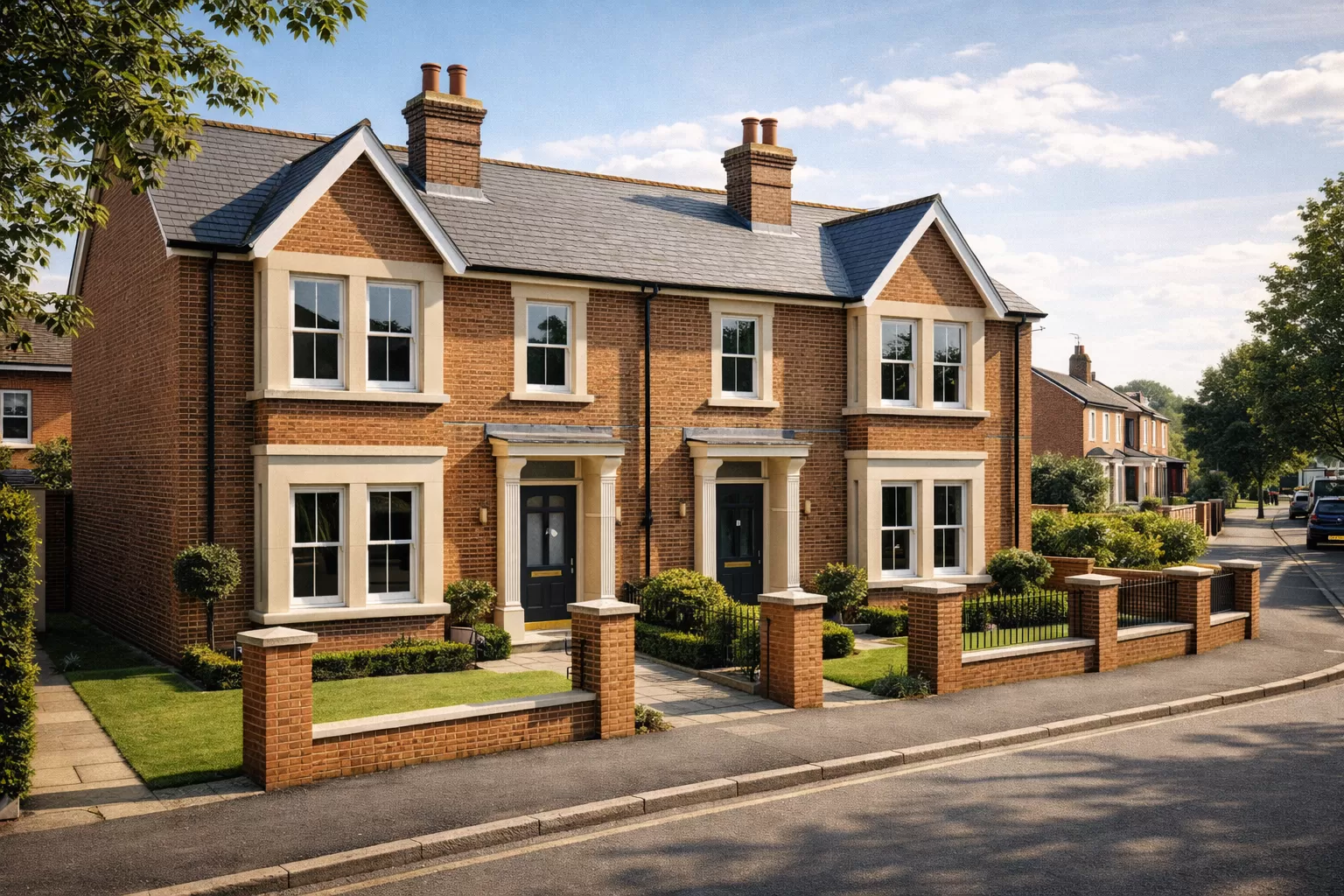
A duplex property in the UK is a residential building that contains two separate living units within the same structure. These units may be arranged side-by-side or across two floors and can either share a single freehold title or exist as separate leasehold properties. Buyers often consider duplex homes because they provide flexible living arrangements, rental income opportunities, or space for extended family members while still functioning as one property structure.
For buyers exploring the UK housing market, understanding how duplex properties work is important before making an offer. The term “duplex” is sometimes used interchangeably with semi-detached homes or maisonettes, yet these property types differ in structure, ownership, and legal classification. This guide explains what a duplex property is, how it works in the UK property system, and what buyers should understand about layout, ownership, and typical use cases.
What Is a Duplex Property in the UK?
A duplex property in the UK is a building that contains two independent residential units within a single structure. Each unit typically includes its own entrance, kitchen, bathroom, and living space, allowing two households to live separately while sharing the same overall building.
The two units may be arranged in several ways. In some cases, they are stacked vertically with one flat on the ground floor and another on the upper floor. In other cases, they are positioned side-by-side with mirrored layouts. The key characteristic is that the building contains exactly two separate dwellings.
Duplex properties are not a formally defined legal category in UK property law. Instead, they are typically classified under broader property categories such as converted flats, maisonettes, or subdivided houses, depending on how the property is structured and registered with the Land Registry.
For buyers, the practical meaning of a duplex usually refers to a property where two residential units exist within the same building, often providing the possibility of owner occupation in one unit and rental income from the other.
In the UK housing market, duplex properties commonly appear in:
- Converted Victorian or Edwardian houses divided into two flats
- Purpose-built buildings containing two residential units
- Homes where the owner lives in one unit and rents the second
- Family arrangements where relatives occupy separate living spaces
Because the UK housing system distinguishes properties primarily through ownership titles rather than building layouts, a duplex may be held under a single freehold title or split into two leasehold flats. The ownership structure has a significant impact on financing, taxation, and future resale.
How Duplex Properties Are Structured
Duplex homes in the UK appear in several structural layouts. While the number of units remains the same—two separate residences—the internal configuration of the building can vary significantly depending on the property’s original design or conversion history.
Understanding these layouts helps buyers determine how privacy, access, and maintenance responsibilities are shared between occupants.
1. Vertical Duplex (Stacked Flats)
A vertical duplex consists of two flats arranged on separate floors within the same building. One unit occupies the ground floor while the second occupies the upper floor. These layouts are common in converted townhouses and period properties.
Each flat usually has its own entrance, though some share a communal hallway or staircase. Vertical duplexes are among the most common configurations found in urban areas.
2. Side-by-Side Duplex
In this configuration, the building is divided into two mirror-image homes positioned next to each other. Each unit typically has its own entrance, garden access, and internal staircase.
This layout resembles a semi-detached house but differs because the structure is often registered as one property containing two dwellings rather than two fully independent houses.
3. Maisonette-Style Duplex
Some duplex homes appear as maisonettes, where each residential unit occupies two levels internally. For example, one household may live across the ground and first floors while another occupies the second and third floors.
Maisonette-style duplex properties are common in dense urban areas where maximising internal living space across multiple levels is necessary.
4. Owner-Occupied Duplex With Rental Unit
Another common structure involves a homeowner occupying one unit while renting out the other. In this arrangement, the property remains under a single ownership title but functions as two independent living spaces.
This setup is particularly attractive to buyers who want to offset mortgage costs with rental income.
Before purchasing a duplex, buyers should confirm:
- Whether the property is legally recognised as one dwelling or two
- If planning permission was granted for conversion into two units
- Whether the utilities and council tax accounts are separated
- How shared maintenance responsibilities are defined
These factors affect mortgage eligibility, insurance requirements, and the property's long-term resale value.
How Duplex Homes Differ From Other UK Property Types
The word “duplex” can create confusion because several UK housing categories appear similar on the surface. Buyers often encounter terms such as semi-detached house, maisonette, and converted flat when viewing listings. Each describes a different structural or legal arrangement.
Understanding these distinctions is essential when researching properties, securing financing, or assessing future rental potential.
Duplex vs Semi-Detached House
A semi-detached house consists of two separate houses that share one central wall. Each home is independently owned, typically with its own freehold title, address, and utilities.
A duplex property, by contrast, refers to a building containing two residential units within one overall structure. These units may be owned by the same person or divided into leasehold flats.
The distinction matters because semi-detached homes are treated as fully independent houses in the UK property system, while duplex buildings may function more like small multi-unit properties.
Duplex vs Maisonette
A maisonette is a self-contained flat with its own entrance, often spanning two floors. Many duplex properties include maisonette units, but not all maisonettes are part of a duplex building.
For example, a four-unit building could contain two maisonettes stacked vertically. In that case, the building would not be considered a duplex because it contains more than two dwellings.
Duplex vs Converted Flats
Converted flats are created when a large house is divided into multiple smaller apartments. If a building is divided into only two flats, it effectively functions as a duplex.
However, once a third unit is added, the property becomes a multi-unit building rather than a duplex.
Buyers should pay close attention to estate agent descriptions, as the word “duplex” may be used informally to describe different configurations depending on marketing preferences.
Why Buyers Consider Duplex Properties
Buyers consider duplex properties in the UK because they provide flexible housing arrangements that can support both residential living and income generation. Unlike single-family homes, a duplex contains two self-contained units, which allows the owner to use the property in several ways depending on financial goals and household needs.
For some buyers, the appeal lies in shared living arrangements. A duplex allows extended families to live close together while maintaining separate private living spaces. For others, the ability to rent one unit while occupying the other can help offset mortgage costs.
Another reason buyers consider duplex properties is long-term flexibility. If household circumstances change, the property can adapt. A homeowner might initially rent one unit but later convert the building into a single-family home or provide housing for relatives.
Duplex properties can also appeal to investors who want to enter the rental market without managing a large portfolio. Owning a building with two units allows diversification within one property asset.
Typical motivations for buying a duplex include:
- Generating rental income from one of the units
- Housing extended family members independently
- Reducing personal housing costs through tenant income
- Investing in small-scale residential property
- Living in one unit while renovating or improving the other
Although these advantages make duplex homes attractive, buyers must carefully assess legal classification, mortgage options, and planning permissions before committing to a purchase.
Ownership Structures for Duplex Homes in the UK
The ownership structure of a duplex property determines how it can be financed, managed, and sold in the future. In the UK, duplex homes typically fall into one of two main ownership arrangements: a single freehold property containing two units, or a building divided into separate leasehold flats.
Single Freehold Duplex
In a single freehold arrangement, the entire building is owned by one person or entity under a single title. Although two residential units exist within the structure, the property is legally treated as one freehold asset.
This setup is common when a homeowner lives in one part of the building and rents the other. The owner retains responsibility for the entire property, including structural maintenance, insurance, and compliance with landlord regulations if a unit is rented out.
Mortgage lenders may classify these properties as either residential homes with a rental component or small multi-unit investments, depending on how the building is used.
Leasehold Duplex Flats
Another common arrangement involves splitting the building into two leasehold flats. Each flat has its own lease agreement and can be owned or sold independently.
In this situation, the freehold may be owned by one of the leaseholders, a third-party freeholder, or jointly through a share-of-freehold structure. Maintenance responsibilities for shared areas are usually defined within the lease agreements.
Leasehold arrangements introduce additional considerations for buyers, including ground rent obligations, service charges, and lease length.
Before purchasing a duplex property, buyers should confirm:
- Whether the building is registered as one title or multiple titles
- How responsibility for repairs and maintenance is allocated
- Whether both units have independent utilities and council tax bands
- If existing leases contain restrictive clauses
Clarifying these factors early can prevent complications during conveyancing or mortgage approval.
How Buying a Duplex Property Works
The process of buying a duplex property in the UK follows the same legal framework as purchasing other residential property, but additional checks are often required because the building contains more than one dwelling.
Buyers should expect both the conveyancing process and lender assessments to examine the property’s legal classification, planning history, and tenancy arrangements if one of the units is occupied.
The typical purchase process includes several stages.
1. Property Search and Evaluation
Buyers first identify duplex properties through estate agents, online property portals, or specialist investment listings. At this stage, it is important to confirm how the property is described legally rather than relying solely on marketing terminology.
2. Mortgage Assessment
Mortgage lenders evaluate duplex properties differently depending on whether the buyer intends to occupy one unit, rent both units, or convert the building into a single dwelling.
Some lenders classify a duplex as a standard residential purchase if the buyer will live in one unit, while others may treat it as a small buy-to-let investment.
3. Property Survey
A survey helps identify structural issues, conversion quality, and compliance with building regulations. This step is particularly important for older buildings that were converted into two units.
4. Legal Due Diligence
The buyer’s solicitor verifies planning permissions, title arrangements, and lease conditions if the property contains separate flats.
Legal checks often include reviewing:
- Land Registry title documents
- Building regulation approval for conversions
- Tenancy agreements if tenants occupy one unit
- Restrictions affecting subdivision or redevelopment
5. Exchange and Completion
Once contracts are exchanged, the transaction becomes legally binding. Completion follows shortly afterwards, transferring ownership of the property to the buyer.
Although the overall purchase process resembles a standard home purchase, duplex properties often require additional documentation because they function as small multi-unit buildings.
Costs Associated With Buying a Duplex Property
Buying a duplex property in the UK involves several financial considerations beyond the purchase price. Because the building contains multiple living units, ongoing costs may differ from those associated with a standard single-family home.
Understanding these expenses helps buyers assess whether the property aligns with their financial plans.
Purchase Costs
Initial acquisition costs for duplex properties typically include:
- Property purchase price
- Stamp Duty Land Tax depending on use and ownership status
- Mortgage arrangement fees
- Survey and valuation costs
- Solicitor or conveyancing fees
Ongoing Ownership Costs
Once the property is purchased, owners should budget for recurring expenses related to maintenance and management.
These costs may include:
- Property insurance covering the entire building
- Maintenance of shared structures such as roofs and foundations
- Repairs affecting both residential units
- Landlord compliance costs if units are rented
- Utilities for shared areas
If the property is divided into leasehold flats, service charges or contributions toward communal maintenance may also apply.
Accurately estimating these costs helps determine whether the income potential or long-term appreciation justifies the investment.
Are Duplex Properties Good Investments?
Duplex properties can be attractive investment opportunities because they provide two income streams within a single property structure. This arrangement allows investors to generate rental income from both units or combine owner occupation with tenant rent.
Compared with single-family homes, duplex buildings may produce a stronger rental yield because multiple households contribute to the property’s income potential.
Investors often view duplex properties as a manageable entry point into multi-unit residential property ownership. The scale remains small enough for individual management while still providing diversification across two rental units.
However, investment success depends on several factors:
- Local rental demand and occupancy rates
- Property condition and maintenance requirements
- Mortgage interest rates and financing terms
- Local planning regulations affecting conversions
- Tenant management responsibilities
Buyers should also consider the long-term exit strategy. A duplex property may be sold as a single building or, in some cases, split into two separate flats if planning permission and title arrangements allow it.
Common Mistakes Buyers Make With Duplex Properties
Duplex properties offer flexibility, but buyers sometimes underestimate the additional complexities involved in owning a multi-unit building. Avoiding common mistakes can prevent legal complications and unexpected costs.
Assuming “Duplex” Is a Legal Property Category
The term “duplex” is commonly used in property marketing but does not represent a specific legal classification within UK property law. Buyers must confirm the actual legal structure through Land Registry records.
Overlooking Planning Permission for Conversions
Some older properties were converted into two units without proper planning permission or building regulation approval. Purchasing such a property can create difficulties when refinancing or reselling.
Underestimating Maintenance Costs
Because duplex properties contain multiple living spaces, repair costs may be higher than those associated with single dwellings. Roof repairs, plumbing systems, and structural maintenance affect the entire building.
Ignoring Tenant and Landlord Regulations
If one unit is rented out, the owner becomes a landlord and must comply with UK housing regulations, including safety certificates and tenancy laws.
Conducting thorough legal checks and financial analysis before purchase helps ensure the property performs as expected.
Planning Permission and Legal Considerations
Buying a duplex property in the UK often requires additional legal checks because the building contains two independent residential units. Even when the structure appears to function as a duplex, buyers must verify that the property complies with local planning regulations and building standards.
Local planning authorities regulate the subdivision of residential properties into multiple dwellings. If a single-family house was converted into two separate units, planning permission and building regulation approval should exist to confirm the conversion was lawful.
Without these approvals, buyers may face challenges securing financing, obtaining insurance, or selling the property in the future.
During the conveyancing process, the buyer’s solicitor will typically investigate several legal aspects:
- Planning permission granted for property conversion
- Building regulation compliance for structural changes
- Land Registry titles confirming ownership structure
- Existing tenancy agreements if the property is partially rented
- Rights of access, shared areas, or communal utilities
Another important consideration involves House in Multiple Occupation (HMO) regulations. In most cases, a duplex with two separate households does not automatically qualify as an HMO. However, if multiple unrelated tenants occupy individual rooms within the units, licensing requirements may apply.
Because regulations vary across local councils, buyers should confirm local planning policies and landlord requirements before completing a purchase.
Mortgage Options for Duplex Properties
Financing a duplex property in the UK is possible through several mortgage structures, but lenders assess these properties differently depending on how the building will be used.
If the buyer plans to live in one unit while renting the other, many lenders treat the purchase as a residential mortgage with rental income considerations. The rental income from the second unit may be factored into affordability calculations.
When both units are rented to tenants, lenders usually classify the purchase as a buy-to-let investment. In this case, mortgage approval depends heavily on projected rental income and the investor’s financial profile.
Some duplex buildings may also qualify for specialist small multi-unit mortgages if the property contains two legally defined flats under a single ownership title.
Key factors lenders typically assess include:
- The number of legal dwellings within the building
- The buyer’s intended occupancy or rental strategy
- Rental income projections for the property
- Property valuation and structural condition
- Local market demand for rental housing
Mortgage availability varies by lender, so buyers considering a duplex purchase often benefit from consulting mortgage brokers experienced with multi-unit residential properties.
Resale Value and Market Demand
Duplex properties occupy a unique position within the UK housing market. Because they offer flexible living arrangements and income potential, they often attract interest from both homeowners and property investors.
Resale demand for duplex properties depends on several local market factors. In urban areas with strong rental demand, duplex homes can appeal to investors seeking properties that generate income from multiple tenants. In suburban locations, buyers may value the ability to house extended family members or create separate living areas.
The property’s ownership structure also influences resale prospects. Duplex buildings that are legally divided into two leasehold flats may appeal to a wider pool of buyers because each unit can be sold individually. By contrast, properties held under a single freehold title may primarily attract investors or multi-generational households.
Property condition plays a significant role as well. Well-maintained duplex homes with clearly separated utilities, independent entrances, and compliant planning documentation tend to achieve stronger market interest.
Before purchasing a duplex property, buyers should evaluate long-term resale potential by considering:
- Local demand for rental accommodation
- Population growth and housing supply in the area
- Future development plans affecting the neighbourhood
- Flexibility to convert or reconfigure the property
A careful assessment of these factors helps ensure the property remains attractive to future buyers or investors.
Frequently Asked Questions
What defines a duplex property in the UK?
A duplex property in the UK is a residential building containing two separate living units within the same structure. Each unit functions as an independent dwelling with its own living space, kitchen, and bathroom.
Is a duplex the same as a semi-detached house?
No. A semi-detached house consists of two separate homes that share one wall but are independently owned. A duplex refers to a building containing two residential units within one structure, which may share ownership or be divided into separate flats.
Can you rent out one unit of a duplex property?
Yes. Many owners live in one unit and rent the other. However, the owner must comply with UK landlord regulations, including safety certificates, tenancy agreements, and property management responsibilities.
Do duplex properties require special planning permission?
If a building is converted from a single dwelling into two units, planning permission and building regulation approval are typically required. Buyers should verify that these approvals exist during the conveyancing process.
Are duplex properties good for first-time buyers?
Some first-time buyers choose duplex properties because rental income from the second unit may help offset mortgage payments. However, buyers should carefully evaluate landlord obligations and maintenance responsibilities before purchasing.
Key Takeaways
- Definition: A duplex property in the UK contains two separate residential units within the same building structure.
- Ownership Structures: Duplex homes may be owned as a single freehold property or divided into separate leasehold flats.
- Buyer Appeal: Many buyers choose duplex properties for flexible living arrangements or rental income opportunities.
- Legal Checks: Planning permission, building regulations, and Land Registry titles must be verified before purchase.
- Market Value: Resale potential depends on location, legal structure, and the property's condition.
References
- UK Government – Planning Permission and Building Regulations Guidance
- HM Land Registry – Property Ownership and Title Registration
- UK Finance – Mortgage Lending Guidelines for Residential Property
- Royal Institution of Chartered Surveyors (RICS) – Residential Property Standards
- National Residential Landlords Association – Landlord Compliance Guidance